
Why Dogs Get the Zoomies
Jump to
Duke had been calm all day. Relaxed. Normal. A perfect golden retriever being a perfect golden retriever.
Then something switched.
His eyes went wide. His butt tucked under. And 70 pounds of golden retriever launched off the couch, ricocheted off the coffee table, lapped the living room three times at full speed, skidded into the hallway, reversed direction, launched himself back onto the couch, and sat there panting like nothing happened.
The whole thing lasted maybe 45 seconds.
I sat there staring at him.
He wagged his tail.
I started Googling.

If you've ever witnessed your dog spontaneously combust into a full-speed blur of fur, tucked butt, and pure chaos — you've witnessed the zoomies. Officially called Frenetic Random Activity Periods, or FRAPs. Which is a very scientific name for something that looks completely unhinged.
They're one of the most entertaining things dogs do. They're also one of the most misunderstood. Here's what I found out about what's actually going on. And if your dog also has a predictable evening freak-out for other reasons, this pairs really well with why dogs bark at nothing at night.
Key Takeaways
- Zoomies are completely normal. Officially called FRAPs — Frenetic Random Activity Periods. Every healthy dog gets them.
- They're almost always a good sign. Zoomies usually mean your dog is happy, relieved, or releasing built-up energy.
- Context matters. Post-bath zoomies mean something different than after-vet zoomies. Both are normal — but for different reasons.
- Puppies get them more. Young dogs have more energy and less self-control. Zoomies are their pressure valve.
- The only real concern is safety. Let them zoom — just make sure the environment is safe.
- You can't really stop them. And honestly, you probably shouldn't want to.
What Are The Zoomies Actually?
The scientific term is Frenetic Random Activity Period. FRAP. Which I think is perfect because it sounds exactly like what it looks like.
It's a sudden burst of high-energy movement — running in circles, figure eights, straight sprints, tucked-butt galloping — that appears out of nowhere and disappears almost as fast. Duke's living room episode lasted under a minute. Most do.
The signature look: eyes wide, butt tucked low, mouth open in what can only be described as a grin. They look possessed. They're not. They're just very, very happy — or very, very ready to explode.

Why Dogs Get The Zoomies — The Real Reasons
Releasing Pent-Up Energy
This is the big one. Dogs build up energy — physical, mental, emotional — and sometimes it needs somewhere to go all at once. The zoomies are that somewhere.
Duke's 6:30 PM episodes happen like clockwork. He's been relatively calm all day, I get home, the energy that's been accumulating since morning finds its exit. One lap around the living room and he's done. Calm for the rest of the night.
Think of it like a pressure valve. The zoomies release it. Once they're done, the dog is noticeably more settled. That's not a coincidence. More walks help, and if your dog needs a little more mental work during the day too, something from the Outward Hound puzzle toy line can help burn off some of that extra energy before the evening chaos kicks in.
Extreme Excitement or Happiness
You come home. Your dog gets the zoomies. That's not random — that's pure, uncontained joy with nowhere else to go.
Dogs don't have the option of jumping up and down and screaming when they're excited. What they have is the zoomies. It's the physical expression of an emotion that's too big to hold still.
Duke gets them when I pick up his leash before a walk. When I open the back door. When his favorite person walks through the front door. The trigger is always something good. The zoomies are the review.
After Something Stressful
This one surprises people. Zoomies aren't always happy — sometimes they're relief.
After the vet. After a bath. After a nail trim. After being in the crate for a long stretch. The zoomies that follow these things aren't joy — they're the nervous system releasing tension that built up during the stressful event.
Duke's post-bath zoomies are legendary in this house. The second I let him out of the tub he tears through every room in the house wiping himself on everything. Part drying off, part "that was horrible and I survived." Both things.
After Pooping
Post-poop zoomies are a very real phenomenon and nobody talks about them enough.
The most popular theory is that it's a relief response — pooping activates the vagus nerve which triggers a release of feel-good signals in the nervous system. The result is a sudden burst of energy that the dog expresses the only way they know how.
Duke does a very specific butt-tuck sprint the moment he's done his business outside. Every single time. It's one of the most reliable things about him. I've started timing it.
The Evening Energy Surge
Many dogs have a "witching hour" — usually somewhere between 5 PM and 8 PM — where zoomies happen with unusual regularity. Duke's is 6:30 PM almost every single day.
This is thought to be the body's natural energy cycle doing its thing. The dog has been relatively calm, energy has built up throughout the day, and the evening is the natural release point before settling down for the night.
If your dog has a predictable zoomie window every evening — that's normal. That's just their rhythm. Once you know it you can plan for it.
Too Much Energy, Not Enough Outlet
Puppies have enormous energy reserves and very little impulse control. The gap between those two things is where zoomies live.
In puppies especially, zoomies can also be a signal of overstimulation — they've taken in too much input and their nervous system needs to discharge. If your puppy starts getting wild and frantic after a long play session or training session, that might be less "joy" and more "I need to decompress right now."
Watch the body language. Playful and loose means happy zoomies. Frantic and unfocused might mean they need some quiet time after.
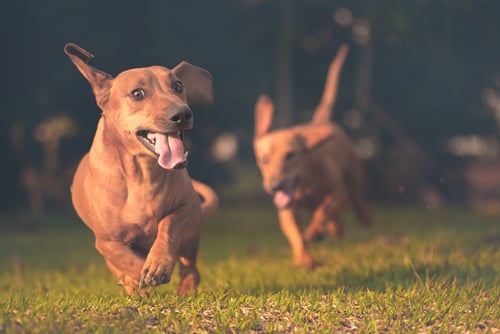
The Different Types of Zoomies
Not all zoomies are the same. Once you know what to look for you start reading them differently.
The Welcome Home Zoom
Triggered the second you walk through the door. Pure joy. The dog has been waiting and the relief of your arrival comes out as full-speed chaos. Duke hits Mach 2 before I've put my keys down.
The Post-Bath Zoom
Part stress relief, part drying off, part "get this shampoo smell off me." Usually involves wiping themselves on every piece of furniture in the house. Always impressive in its commitment.
The Post-Poop Zoom
The vagus nerve relief response. Happens immediately after a successful bathroom trip. Completely normal. Highly entertaining. Duke's personal signature move.
The Pre-Walk Zoom
You picked up the leash. The anticipation was too much. The zoom happens before the walk even starts. By the time you actually get outside the dog has already run the equivalent of a mile in your living room. A comfortable harness and simple leash setup make that part easier at least.
The Evening Witching Hour Zoom
Predictable. Regular. Happens at the same time every day. This is your dog's daily energy reset. Consistent exercise during the day reduces the intensity of these — but usually doesn't eliminate them entirely.
The After-Vet Zoom
Stress release. That was awful and now it's over. The nervous system celebration of surviving something terrible. Duke's post-vet zoom has a specific "we got through it together" energy I find deeply relatable.
Are Zoomies Good Or Bad?
Good. Almost always good.
Zoomies are a sign of a dog who has emotions they need to express and the physical ability to express them. A dog that never gets zoomies isn't necessarily a calm dog — it might be a dog that doesn't feel safe enough to let go.
The only real caveat is context. If zoomies are happening constantly — like every hour, all day — that might indicate the dog isn't getting enough physical and mental stimulation throughout the day and the pressure valve is working overtime. More exercise, more enrichment, and the frequency usually comes back down.
Keeping Them Safe During Zoomies
The behavior itself is fine. The environment is where things can go wrong.
| Situation | The Risk | What To Do |
|---|---|---|
| Hardwood or tile floors | Slipping, sliding, joint strain | Rugs, mats, or redirect outside |
| Wet grass or icy surfaces | Slipping, falling, injury | Keep inside until conditions improve |
| Furniture in the path | Collision injuries, broken items | Clear a path or take it outside |
| Small spaces | Sharp turns, collision risk | Open the back door — give them room |
| Senior dogs | Joint strain, soreness after | Let them go but monitor — watch for limping afterward |
| Near stairs | Falls | Block access to stairs during zoom mode |
The Bottom Line On Zoomies
Duke still does his 6:30 PM living room circuit. Still tucks his butt and hits top speed and ricochets off the couch like he weighs nothing.
I stopped questioning it and started appreciating it. A dog who gets the zoomies is a dog who feels safe enough to completely lose their mind for 45 seconds in front of you.
That's trust. That's comfort. That's a dog who's happy.
Let them zoom. Just move the coffee table first.
Frequently Asked Questions
Do zoomies mean dogs are happy?
Usually yes — but not always. Most zoomies are a sign of happiness, excitement, or energy release. But zoomies can also happen after stressful events like baths or vet visits as a way of releasing nervous tension. Either way they're normal. The context tells you which one it is.
Why do dogs get zoomies after a bath?
A few things happening at once. The bath is stressful for most dogs so there's relief energy to burn off. They're also trying to dry themselves and — importantly — trying to get rid of the shampoo smell by rubbing themselves on everything. Post-bath zoomies are one of the most reliable dog behaviors there is.
Why do dogs get zoomies at night?
The evening witching hour is real. Most dogs have a natural energy cycle that peaks in the late afternoon or early evening — usually between 5 PM and 8 PM. If your dog hasn't had enough physical and mental stimulation during the day, that energy needs somewhere to go. More daytime exercise usually reduces the intensity of evening zoomies.
Why do dogs get zoomies after pooping?
The most common theory is that pooping activates the vagus nerve which triggers a release that feels physically relieving. The result is a sudden burst of energy — a kind of nervous system celebration. Post-poop zoomies are extremely common and completely normal. Duke has never once skipped them.
Are zoomies good for dogs?
Yes. Zoomies are a healthy, natural way for dogs to release energy and express emotion. A dog that gets the zoomies is generally a healthy, happy dog who feels safe enough to let go completely. The only concern is the environment — make sure they have space and safe footing so nobody gets hurt.
Why does my dog get zoomies when I come home?
Because you're the best thing that happened to them today. The joy of your arrival is too big to hold still. Zoomies are the physical expression of an emotion that has nowhere else to go. If your dog zooms when you walk in the door — that's one of the best reviews you can get.
Why do dogs get zoomies all of a sudden?
Because the trigger doesn't always look obvious to us. Something shifted in their energy — a smell, a sound, a memory of something exciting, the body's natural energy cycle hitting its peak. It can look completely random from the outside. From the inside, something definitely happened. We just don't always get to know what.
How do I keep my dog safe during zoomies?
Clear the path or redirect them outside. Watch out for slippery floors — hardwood and tile are injury risks during high-speed turns. Avoid wet grass or icy surfaces. Block access to stairs. For senior dogs, let them zoom but watch for soreness or limping afterward — older joints don't always recover as fast.
Duke did his 6:30 PM lap around the living room while I was writing this.
Tucked butt. Wide eyes. Full send.
Forty-five seconds of pure chaos.
Then he came and sat on my feet.
Give your dog some love today. 🐾
Welcome to The Pack. 🐾


